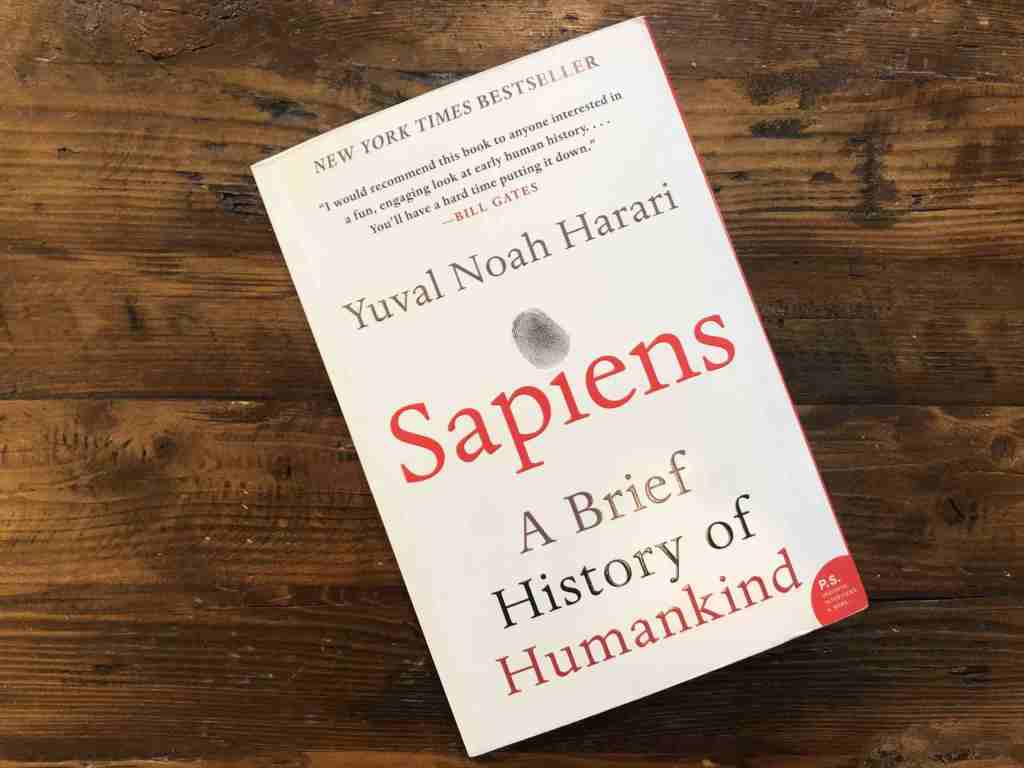
It all started with the Big Bang. From there came Physics encompassing Matter and Energy. Then came Chemistry delving into atoms, compounds, and molecules. And finally emerged Biology, focusing on self-replicating biochemical units and cells, eventually giving rise to all living organisms, including us.
But wait, what do we mean by us? Humans? Well, Homo sapiens, to be precise, for there were other human species in the past (the likes of Homo Erectus, Neanderthals, etc.) This raises the immediate question: How did humans, seemingly average organisms, embark on a journey from caves to space and come to dominate other organisms, including their Homo siblings? The answer lies in the name: “Sapiens.”
As you see, the word Sapiens means wise, and there’s a reason Humans call themselves wise (apart from the obvious smug reason!) As explained by Cognitive Revolution, certain mutations in the brain helped Homo sapiens use their brain in innovative ways. They could not only think of new ways to organise material things, but also ideas, and more importantly their sounds. Yes, the ability to create language. Language then helped them create their most potent weapon, the one that would help them work in groups.
The potent weapon is the human ability to create myths and fiction. Yep. If you look around, everything we believe in — money, country, religion, corporations, constitutions — is essentially fiction. Fiction unites us and holds true only because a large number of people believe in them. Working in groups meant collective intelligence, which enabled Homo sapiens to outlive their siblings and trace their journey into space. Think this way: At an individual level, a human might struggle against a chimpanzee, but in a battle of 1000 humans vs. 1000 chimpanzees, it’s a totally different story.
Just as the Cognitive Revolution explains the above questions, three other revolutions help trace our journey: the Agricultural Revolution, the Scientific Revolution, and the Industrial Revolution.
The Agricultural Revolution resulted in a surplus of food and resources, liberating humans from constant roaming. It necessitated efficient resource management, leading to the diversification of human roles. So, the easy convenient one line is to say: It allowed the wandering humans to create villages, cities, priests, and kings. Except, there’s always more to the story. While it allowed the human species to flourish and multiply at the species level, at the individual level, one could argue it led to a lower quality of life. In settling down, people became fixated, planning their lives around domesticated plants. In a way, it’s like wheat domesticated the human, not the other way around.
Then came the Scientific Revolution, propelling humans to look beyond the supernatural for answers about the world. The shift from attributing natural phenomena to gods to pursuing Science led to the birth of Physics, Chemistry, Biology, and other sciences. Science fostered new ideas, inventions, and innovations, ultimately giving rise to the Industrial Revolution. Humans could create machines not just to aid daily work but to control the world in unprecedented ways. Now, with these machines, humans stand on the brink of yet another revolution — the Artificial Intelligence Revolution.
Returning to the main idea, the creation and transition of these three revolutions were possible only because of our ability to create fiction. No other fiction played a larger role than Religion, Money, and Empire, the three greatest unifiers.
Religion, as the first unifier, not only created groups based on shared beliefs but also provided the foundation for rules and morals necessary for collective living. Money, the second unifier, took it a step further, enabling even random people to collaborate. Empire, the third unifier, in one way or another (often via force), brought people of different cultures together. While a quick tour of history may cast a positive light on these unifiers, they have had a dark side too, creating some of the darkest episodes throughout history. No other event epitomizes this more than the Age of Exploration and Colonialism, born out of religious fanaticism, monetary greed, and imperial jingoism.
Even today, if we look around, the influence of these three unifiers remains central to our lives. One might mistakenly think the era of empires is over, but in reality, we are living in an even bigger empire — the global empire — dominated by a few key players.
My takeaway:
Sapiens played a pivotal role in my reading journey, as it was one of my first books in history. It was an eye-opener on a lot of ideas and a stepping stone for other influential books. This quick rewind doesn’t touch upon many important topics, such as the absence of justice in history, the origin of male dominance over females, the good, bad, and ugly side of Capitalism, and the future of humanity and our world. So, grab the book and discover it on your own!






 Nepali Wanderer
Leave a comment