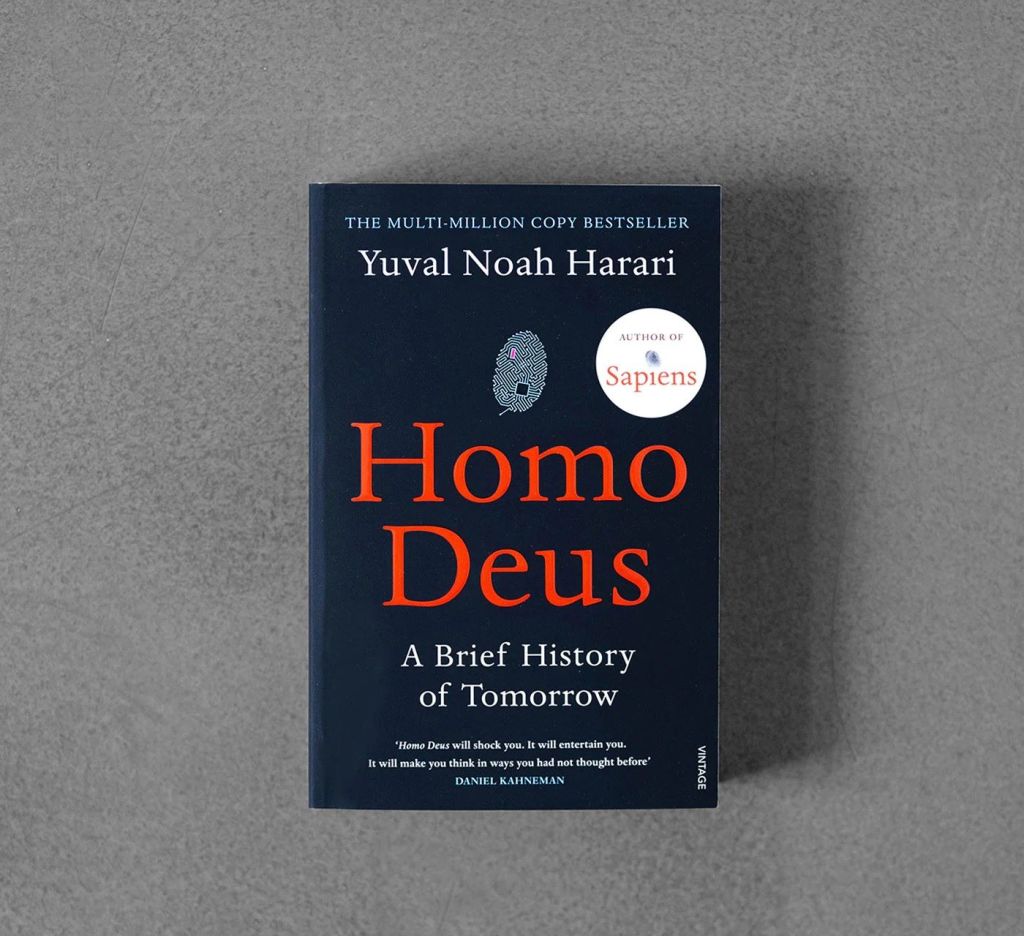
Throughout most of human history, we grappled with three primary challenges: Famine, Plague, and War. While these challenges persist, we’ve made significant strides in mitigating their impacts. However, history doesn’t allow a vacuum. So, modern humans will look to overcome three new challenges in the future.
- Fighting against death (Immortality)
- Seeing eternal happiness (Mostly via biochemical means)
- Aspiring to God status (Hence the name, Homo Deus!)
To comprehend how we’ve arrived at a point to even contemplate these challenges, it’s essential to grasp why only humans entertain such fantasies. What drives them to envision defying death, attaining eternal happiness, and ultimately ascending to god status?
Well, the reason they can even think of these fantasies is because of their ability to imagine different realities. The reason how they have reached this point is because of their ability to create fiction and turn them into realities, a concept much discussed in his earlier book Sapiens, summarised here.
Fiction has made it possible for humans to work in groups, and create inter-subjective realities. Organising around these constructs has been a recipe for human success, whether through the establishment of religion or the advancement of modern science. While religion and spirituality seem like a similar concept, religion is actually closer to science in many ways. Both are goal-oriented (spirituality is a journey), and both want to maintain order. Like religion and science, humans also believe in two other fiction strongly.
The first is Capitalism, which has become the ultimate religion for many. As the economy ceases to be a zero-sum game, thanks to its perpetual expansion, human confidence in the future has soared. Growth has become the ultimate mantra and a driving force behind overcoming (or at least mitigating) our previous challenges. War is costly, and groundbreaking scientific advancements are financially rewarding — both driven by Capitalism.
But is it driven by Capitalism alone? No, because Capitalism alone would have meant the open sale of even state and law and police, much like slavery in the near past. It’s because of another religion which we come to call ‘Humanism’.
Humanism, superficially encompassing concepts such as human rights and purpose, ultimately centers around the individual and their subjective experiences. It’s about you, and how you feel. It is the very lure of you that makes you imagine the prospect of eternal happiness, or even ultimately being god. This is where Homo Sapiens risk losing control to algorithms. Given current trends, algorithms could gauge an individual’s comfort level by monitoring physiological markers such as blood pressure, heart rate, and blood sugar levels. Thus, it’s conceivable that soon algorithms could know more about you than you do! In pursuit of these fantasies, humanism could evolve into another fiction known as dataism.
Dataism is a fiction that treats the World as a Data Processing System. Even the entire human population can be thought of as a single data processing system, where individual humans serve as its chip. Even capitalism and communism can be seen as variants of data processing systems (decentralised versus centralised processing). Above all, it could make humans believe that they are only valued if they feed their data into this system, making them voluntarily convert their experiences into data points. Ultimately, it could mean humans relinquishing their decision-making authority to algorithms.
My takeaway:
Okay, the first thing I admit here is my frailing memory and half-baked notes from the book, which have made it difficult to coherently piece together everything. (See, detailed note-taking is important!) Nonetheless, my key takeaway from the book revolves around the rapid pace of radical breakthroughs, particularly when viewed through the lens of history condensed into a single frame. It prompts me to imagine outlandish scenarios that could materialise in unimagined ways. As Harari aptly puts in the book: “We learn history not to predict the future, but to free ourselves from the past and imagine alternative destinies.”





 Nepali Wanderer
Leave a comment