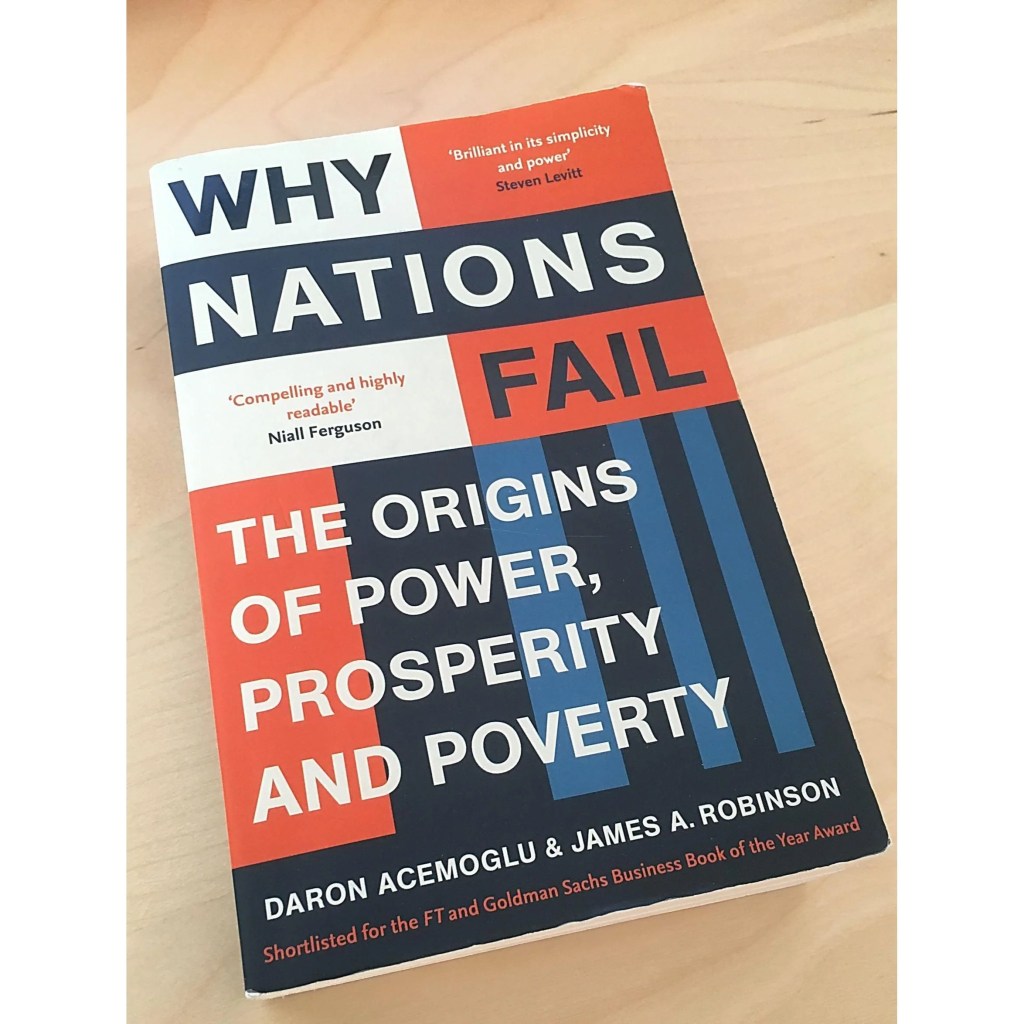
When discussing the development of a region or country, we often think of geography, which includes available natural resources, location, and geopolitics. Or we consider culture, examining how people live and what values they pursue. But what about regions similar in terms of both nature and culture? Examples abound, such as North Korea vs. South Korea. The authors pinpoint a different reason for the divergent paths of nations in terms of development and prosperity.
The book starts with a perfect example: a place called Nogales that lies in both Mexico (State of Sonora) and the United States (State of Arizona). For a long time, it was the same region, sharing similar geography, people, and culture. Yet today, the two Nogales are worlds apart in terms of basic amenities, average income, lifespan, security, and law and order. The biggest underlying factor for this divergence is the presence or absence of proper institutions. Among these, the most important are economic and political institutions.
Politics is the process by which a society chooses the rules that will govern it, making political institutions crucial. Societies with good political institutions provide the platform necessary for robust economic institutions. To dissect institutions favorable for prosperity, the authors introduce two types: inclusive and extractive.
Inclusive institutions enable a large population to choose the laws and policies they want and engage in economic activities suited to their skills and interests. These institutions often feature secure private property, strong unbiased law and order, and public services that provide a level playing field. Extractive institutions, on the other hand, are designed to extract income and wealth from one subset of society for the benefit of another, with a few elites controlling the law for their economic benefit. While plurality is important for inclusive political institutions, a certain degree of a strong centralized state is also necessary to maintain law and order for inclusive economic institutions. The authors cite Somalia as an example (and could apply to any country with civil wars) where the distribution of power without a strong state leads to chaos, uncertainty, and lawlessness.
Political and economic institutions are in a feedback loop. Depending on their nature (extractive vs. inclusive), they go through a positive or negative cycle. Strong inclusive political institutions lead to an even distribution of wealth and income, which in turn leads to an even distribution of power. Extractive political institutions lead to the opposite, reinforcing more extractive institutions in a vicious cycle.
Now, the pertinent question for us is: why are some institutions inclusive and others extractive? Political institutions are often shaped by social hierarchy, requiring us to look back in time. A simplified history traces human development from hunter-gatherers to agricultural societies, leading to hierarchy and inequality. Once a region develops social hierarchy with inequality, elites strive to maintain the status quo, creating institutions (political and economic) that favor them. This leads to conflicts, battles, and revolutions, as sections of society attempt to challenge or uphold this hierarchy. However, history is contingent, influenced by events and episodes beyond control, with certain regions benefiting from being in the right place at the right time.
The authors highlight the example of England as a turning point, illustrating how the transition from extractive to inclusive institutions led to its rise. Post-Roman Empire, feudalism emerged in many parts of Europe, including England. Feudalism, despite its flaws, led to a form of decentralization pivotal to the eventual weakening of the monarchy in the UK. After a series of conflicts between monarchs and a coalition of elites, the latter triumphed, leading to the formation of parliament. This shift towards inclusive political institutions paved the way for inclusive economic institutions, fostering innovation and eventually the Industrial Revolution in England.
This also had significant implications for institutions worldwide, like example of Mexico vs USA above. Spain, colonizing regions with existing hierarchies and resources, implemented a purely extractive model, forcing natives to work for the elites and the monarchy. In contrast, the colonization model in much of North America involved settlers creating more egalitarian institutions (among the rulers, as the system still had slavery). Note that this occurred alongside other dark episodes, such as the forced relocation of Native Americans and their decimation in wars. The separation from the UK and the formation of the Union (USA) led to even more pluralistic, inclusive political institutions, resulting in more inclusive economic institutions and a virtuous cycle.
A similar story unfolded in Australia, where extractive institutions couldn’t be established due to the lack of available human resources. Interestingly, this also happened in Argentina, despite Spanish colonization, because it lacked the existing human hierarchy found in other parts of Spanish America. Similarly, post-French Revolution, Napoleon’s conquest of much of Europe paradoxically made these regions more inclusive, making them more suitable for industrialization. (From the examples given, it seems that places with no hierarchy and past riches are better positioned to make that leap than those burdened with them.)
The authors also examine examples where growth and prosperity have emerged from extractive institutions but not sustainably. Continuous growth requires creative destruction, which extractive institutions resist to maintain stability. This resistance to innovation ultimately leads to stagnation and decline. Historical examples include the Ottomans resisting the printing press, Russians resisting railroads, and Chinese reversing ship voyages. Extractive institutions also often face internal conflicts among elites for power, leading to the downfall of once-glorious cities and civilizations, such as the Maya civilization and Venice.
The dynamic nature of institutions means they are always evolving and could change direction. Recent examples include South Korea and the Soviet Union. Both had politically extractive institutions in the 1950s, leading to economic growth for a time. However, South Korea moved towards more democratic inclusive institutions, sustaining its economic growth, while the Soviet Union collapsed for failing to do so. In this regard, the authors make a bold prediction, casting doubt on the long-term sustainability of China’s current model.
My Takeaway
The book was enlightening in analyzing the development and prosperity of countries in terms of systems. Many least developed countries still have extractive institutions inherited from colonial days or earlier empires and monarchies. The authors mention Nepal as an example of a country struggling with prosperity due to extractive institutions (without delving deeper). So, this has been a valuable lesson for me to analyze my own country and understand why we still struggle.
However, there are further unanswered questions. For instance, why is there inequality within the same country, that too in some of the first world countries with inclusive institutions. To explore some of these inequalities, we must delve into dark episodes of history, such as slavery and colonialism. On a side note, a similar question should be: how much of the West’s prosperity is due to institutions versus exploitation through slavery and colonialism, and vice versa for poorer countries.
If we talk about inequality, forget same country, we should actually ask: why is there inequality between members of the same household (gender based). To understand the origins of inequality and its different forms, we need to go back even further in history.
Yet, there is an important broader perspective often overlooked. We tend to accept inequality as a given, as if it is an inevitable by-product of civilization. However, it’s crucial to question whether inequality is truly inevitable. To delve into this, I turned to “The Dawn of Everything” by anthropologist David Graeber and archaeologist David Wengrow.






 Nepali Wanderer
Leave a comment