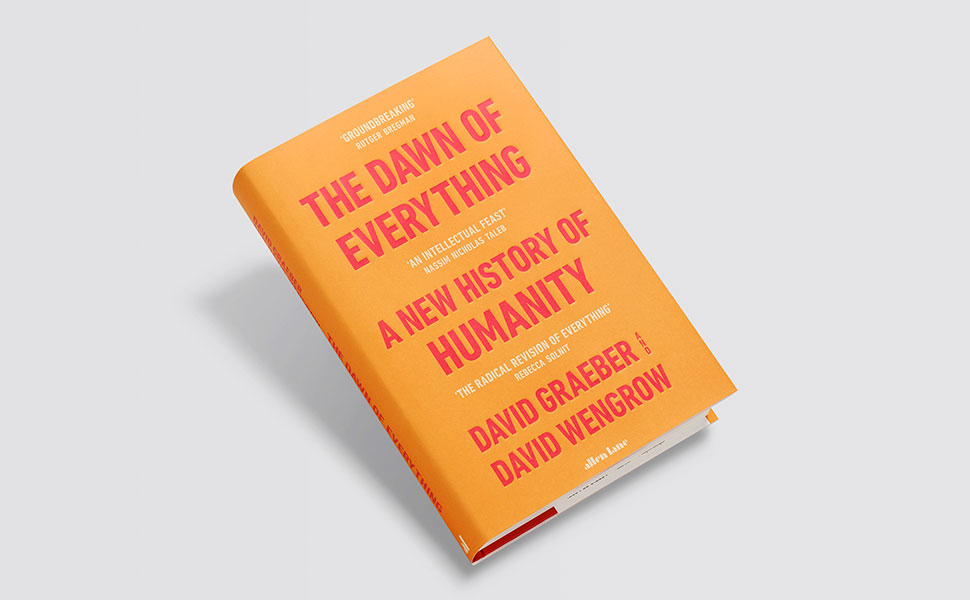
If we think of the entire human history, we get a smooth linear picture. For most of our prehistory, we lived as nomadic hunter-gatherers. Then, around 10,000 years ago, the agricultural revolution happened, which led to people settling down, making cities and hierarchies, right up to our modern-day states. There’s nothing wrong with this picture, as most acclaimed books paint us this story (Sapiens, Guns, Germs and Steel, etc.). Except, this picture itself is wrong, which is what the authors David Graeber and David Wengrow argue in the book The Dawn of Everything.
Apart from minor inaccuracies here and there, what is so wrong with the smooth linear picture, you might ask? After all, much of our ancient history is unknown, so it’s bound to have some errors and inaccuracies, right? Well, the only problem with this smooth linear picture is that it paints the entire human story in a deterministic manner, as if the current state of the world was bound to happen, thereby making everything, good or bad, seem inevitable, like inequality which we talked about in our previous story. That’s why the authors put a lot of effort into busting some of the myths related to the smooth linear picture.
First Myth: Cities, Civilizations, and Hierarchies Came Into Place Only After the Agricultural Revolution
Recent archaeological evidence, like Göbekli Tepe, shows that there were massive structures even before the advent of agriculture. To create such structures, it required the cooperation of humans in massive numbers, meaning there must have been civilizations and hierarchies even then. Maybe the hierarchies were fluid, maybe the hierarchies were temporary and seasonal, or maybe the hierarchies were just as rigid as today (which we will discuss below). But one thing is for sure: the agricultural revolution is not a prerequisite for civilization and hierarchy.
Second Myth: The Savage Indigenous Theory
There is still a prevalent notion that our forest ancestors were closer to the chimpanzees than us, which is to say, savages and intellectually inferior. The consequence of this is that the same picture got painted for most indigenous people of the world. Especially when the Europeans encountered the native people of America, the natives were seen as savage “uncivilized” people. Slowly over time, the erroneous equivalence of egalitarian = prehistoric = nomadic = savages developed. So, anyone who aspired not to be savage had to live up to an unequal hierarchical advanced structure, for this seemed the only inevitable alternative from the equivalence.
In reality, the indigenous natives were far from the savages they are often portrayed as. Most native societies had not only different social structures but different perspectives on life. The authors claim that some Enlightenment ideas in Europe were actually inspired by the natives, ideas like “personal freedom and liberty,” which are more common in egalitarian societies. Interestingly, when the natives encountered the French, they saw themselves as richer than Europeans, for they had more time, ease, and comfort over materialistic possessions. (This should make us evaluate our idea of progress and prosperity.)
The two myths serve two purposes for the myth-makers. The first is creating the prevailing notion that the rise in scale will lead to the rise of complexity, meaning the rise of hierarchy and inequality. The second is trumpeting the glory, necessity, and inevitability of the agricultural revolution to justify the elimination of indigenous non-agricultural societies. For a long time, our prehistory was anything but uniform and was made up of a myriad of social arrangements and structures: some small, some leading to large cities, some egalitarian, some based on hierarchies. Even the hierarchies were diverse in nature, from fluid to seasonal to rigid. Inequality existed but was often temporary and subject to change through revolutions and social upheavals.
Thus, it seems for a long time we were just experimenting with different social forms, organizing and dismantling hierarchies. In fact, it took almost 3,000 years to go from wild cultivation to domestication, so nothing short of a “revolution” in regard to agriculture.
Therefore, rather than asking how or when inequality rose, the pertinent question should be: How did we get stuck?
Stuck in Inequality
The authors highlight two parallel developments that made us stuck in the current world order: the rise of the state (in terms of structure, for it is difficult to trace the exact rise of the state) and the loss of three freedoms (more on this in a while). The agricultural revolution facilitated resource hoarding, but the real turning point was the transformation of wealth (resources) into power, which happened through state structures. Bureaucracy institutionalized inequality (via documentation of debt) and the army institutionalized violence (via its legalization in the name of the state). In parallel, it led to the loss of three freedoms that humans had enjoyed for a longer part of human history.
The Loss of Three Freedoms
- Freedom to move around
- Freedom to disobey
- Freedom to experiment with new lifestyles and social orders
State structures continue to restrict these freedoms, normalizing inequality and violence to maintain the current social order. And if we delve deep into why we acquiesce — from “because it’s the normal thing” to “because it’s law” — it all boils down to it being enforced by the state, often through violence. Now, you might find this too radical, but the point here is not to question the legitimacy of the state but to acknowledge the normalization of violence.
Even gender inequality became a normalised structure due to the normalisation of violence and the loss of three freedoms by females. If we look at history, many societies were matriarchal, for the simple reason that mothers are the natural obvious parents. The prevalence of female deities across many ancient societies (and even today in some religions and especially tribal societies) highlights the eminence of females in human history. If you analyse step-by-step, you will realise how the loss of the first freedom (ability to move around) led to the loss of the second (ability to disobey), which led to the loss of the third (ability to try out new things), and how we became stuck.
Conclusion
For the social structure that we have now and are stuck in, the book does not offer a sure-shot answer or solution for a utopian egalitarian world. So, you might ask, what’s the goal of the book? (Just to bust myths?) Well, the goal of the book is: First, to make us aware that we are stuck, and second, to make us aware that there could be alternatives, thereby making us imagine those alternatives. By showing us it’s not inevitable and there were alternatives in the past, it tells us how we can change the course of history by literally changing our understanding of it.
My Takeaway
The Dawn of Everything was a challenging read due to its volume and the new perspectives it presented. However, it was profoundly impactful, prompting me to question some of my own learnings and established narratives about human history and consider the possibility of alternative social orders.
Now that we know inequality is not inevitable, and there were alternatives in the past (meaning there could be in the future), it is important to keep experimenting. So, to learn about equality (enough about inequality :P) and the possible paths toward it, I turned to the book on equality by Thomas Piketty. Also, now that we have talked about the normalisation of violence and inequality, I will also touch upon two of the darkest episodes related to both in our next story: slavery and colonialism.





 Nepali Wanderer
Leave a comment