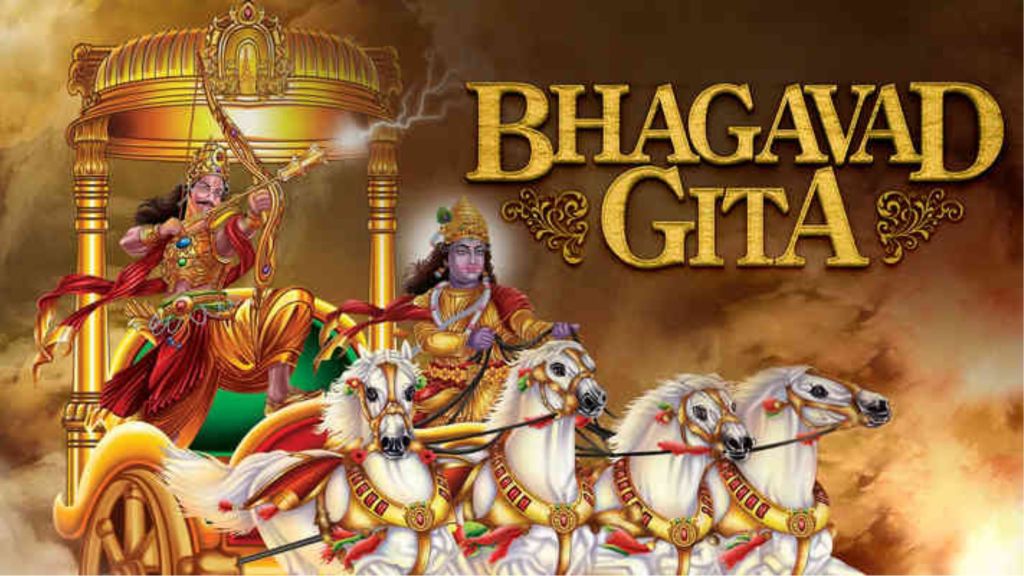
The Gita is one of the most important books in the world. Within Hinduism, the Gita holds a unique place as it encapsulates the diverse philosophies within it. It explains the essence of the Upanishads, sheds light on various paths (and definitions) of yoga, and encompasses other philosophies like Samkhya.
What sets the Gita apart from other spiritual books is that it is not just an esteemed but arcane scripture. Rather, it is a book loved by the masses, and there is a reason for this popularity. Literally meaning the Song of God (Bhagavad Gita), it is a story in the form of a song. Like any captivating story, it has all the ingredients to engross readers from start to finish. And above all, it provides timeless teachings and wisdom applicable not just for spiritual seekers but more so for everyday people.
The Gita begins with a backdrop, that in itself is one of the greatest stories of all time, the Mahabharata. Then, the second chapter provides a condensed summary of the entire story, like a scene from a climax featuring at the beginning. The subsequent chapters then delve into the concepts introduced in the summary, enlightening a curious, albeit confused, audience. The entire Gita is a conversation between a student and a teacher, where the student Arjun, like us, seeks wisdom. This wisdom is imparted by Krishna, not only the wisest being in the Mahabharata but also an avatar of God.
Chapter 1: Arjun Bishad Yoga
The story begins with Sanjay narrating the events of the Mahabharata to Dhritarashtra. The Mahabharata is a war between the Pandavas and the Kauravas, sons of two brothers, Pandu and Dhritarashtra. As Dhritarashtra is blind, his charioteer Sanjay narrates the story to him, which in our case, is the conversation between Arjuna and Krishna.
The scene opens with thousands of warriors on the battlefield, about to engage in the greatest war of all. Seeing his loved ones (especially his beloved grandfather and teacher) on the enemy side, Arjun is filled with grief and confusion. He believes whatever be the outcome of the war, it will be a lose-lose situation. Moreover, he feels that his actions will go against Dharma, leading him to resign and give up.
Chapter 2: Sankhya Yoga
Engulfed in sorrow, Arjun believes he won’t feel happy even if he wins all the wealth in the world. He thinks he would rather live the life of a monk than wage this war. Realising he has lost his ability to discern right from wrong, he pleads with Krishna to show him the way. Only then Krishna speaks, finally.
At the beginning, he talks about the futility of worrying about death, saying that the wise never show grief, neither towards the living nor the dead.
He explains about Atman, the imperishable inner Self. He tells Arjun that death is just the end of the perishable body. The immortal Atman changes bodies after death, much like people change clothes. Therefore, he says it is futile to worry about something similar to people changing clothes. Regarding dharma, he explains that performing one’s duties without expectations or worries about the outcome is the true dharma. In this particular case, he tells Arjun that waging the war he is meant to fight is his true dharma.
As Arjun is curious about the spiritual way of life, Krishna then talks about pleasure and pain. He says all fleeting pleasures and pain arise from the senses. Our senses, if uncontrolled, run after the sensory world, and never-ending desires are thus born. These desires then give rise to greed and lust, which, when unfulfilled, give rise to anger. He then lays out the secret to controlling desires. Krishna says that mere denial or suppression of the senses won’t eliminate desires. Rather, only a taste of a superior experience will naturally make a person give up on sensory pleasures.
He then talks about the three Gunas (qualities) that constitute the natural world and the need to go beyond these Gunas to experience the Atman (Self). He briefly touches upon the concept of Yoga and explains Yoga in terms of detachment and excellence in work.
As mentioned earlier, the second chapter is a summary of the entire story. Therefore, it is bound to make Arjun curious and yet confused. In the subsequent chapters, Krishna will remove this confusion by explaining in detail these key concepts: Atman, Dharma, Yoga, and Gunas.
Chapter 3: Karma Yoga
In Karma Yoga, Krishna emphasises the importance of work (literally Karma) as the most fundamental aspect of life. Regardless of the path people follow, whether as householders or recluses, they still have to perform certain tasks. Even to survive, we must engage in a series of actions every second (like breathing), and there is work necessary for even basic nourishment.
Regarding what work to do in life, Krishna advises that we should engage in work that aligns with our nature. All of nature, including us, is composed of three Gunas: Satva, Rajas, and Tamas. Thus, we should first understand our nature and then perform work that best suits it. He also notes that doing one’s work (even with limited success) is far better than doing another’s work (even with utmost success).
Arjun then asks Krishna why people perform sinful actions. Krishna explains that it is due to desires arising from the sensory world. Greed, lust, and anger from unmet desires lead people to sinful actions. Therefore, it is crucial to understand this distinction and defeat our true enemy — desire, the root cause of sin. To defeat this enemy, the key is to control our senses and mind. Krishna explains that the senses are inferior to the mind, the mind is inferior to the intellect, and the intellect is inferior to the Self.
Chapter 4: Gyana Karma Sanyas Yoga
In this chapter, Krishna discusses Yoga, the union of Atman (the inner Self) with Brahman (the supreme Self). He lays out various paths for achieving this union, or the ultimate bliss state known as Samadhi. Today, these paths are commonly known as the Four Paths of Yoga: Gyana Yoga, Raja Yoga, Karma Yoga, and Bhakti Yoga.
(Note: Krishna discusses the path of Dhyana (Meditation) throughout the Gita, while focusing on three other paths in this chapter. It was Vivekananda who later compiled these paths together as the Four Paths of Yoga.)
Gyana Yoga is the path of reading spiritual books and engaging in self-inquiry, using intellect to realise the Self. Raja Yoga includes meditation, asanas (physical yoga postures), and pranayama (breath control) to control the senses and mind. Karma Yoga is the path of selfless work and work done without any expectation of outcome. Bhakti Yoga is the path of devotion to God. Each path, despite its different approach, naturally gravitates toward the same destination: self-realisation.
Chapter 5: Karma Sanyas Yoga
Arjun, having learned about the different paths of Yoga, requests Krishna to recommend a path for him. To clarify his understanding, Arjun divides the paths in terms of work: whether to follow the path of a recluse who performs minimal worldly work or a householder more involved in worldly affairs.
Krishna emphasises that certain work is involved in all paths. He recommends that Arjun follow the path involving regular work but stresses the importance of blending this work with Bhakti Yoga. This means doing one’s work without attachment to the results and seeing every task as an act of devotion to God.
Chapter 6: Atma Samyam Yoga
Yoga requires controlling the senses and mind. But controlling the mind, in particular, is a difficult task, as Arjun points out at the beginning of this chapter.
Krishna advises Arjun that to control the mind, one must avoid extremes and follow the middle path (just like Buddha recommends). He says that those who eat too much or too little, sleep too much or too little, or perform any action in extremes cannot control their mind and become true Yogis. He also advises Arjun to practice Samata (equanimity), treating everything — pleasure or pain, friends or enemies — in the same manner. Avoiding extremes and practicing Samata will help maintain self-control (Atma Samyam) and realise the bliss state.
Lastly, Arjun asks what happens if someone strives for the spiritual path all their life but fails at the final hurdle. Will this cancel out everything and result in neither spiritual nor material success? Krishna reassures that every effort counts, and even if one fails at the final hurdle, the person will reap the benefits of their work in other forms, whether in this life or future ones, in line with the law of karma.
Chapter 7: Gyana Bigyana Yoga
In this chapter, Krishna discusses the ultimate knowledge, the understanding of which renders all other knowledge redundant. This is the knowledge of the Supreme Self, Brahman.
Krishna explains to Arjun that everything in the Universe is composed of Brahman. Brahman is immortal, immanent, and infinite, transcending time, space, and causality. On the superficial level, nature (a combination of sentient and non-sentient entities) is composed of the three Gunas. But beyond these Gunas lies Brahman.
Krishna also notes that people with limited knowledge worship gods and goddesses without realising that Brahman is the ultimate entity beyond these deities. They may attain some bliss by accessing other Lokas, but this bliss is limited and transient. Only by realising Brahman can one achieve unlimited, permanent bliss. In Sanskrit, knowledge is called Gyan, and experiential knowledge is called Bigyan. Thus, Krishna encourages Arjun to personally experience this knowledge.
(Note: I like to see these Lokas as different states of consciousness. Many of these states are limited and transient, like Indra Loka and Deva Loka, while Brahman represents the ultimate state of pure consciousness that is infinite and permanent. Also, Indra Loka could be the state of consciousness arising from heavenly sensory pleasure, as the word Indriya means sense organs.)
Chapter 8: Aksara Brahma Yoga
Aksara means “imperishable” in Sanskrit. (The word for letter is also Aksara in Sanskrit and Nepali, reflecting the imperishable nature of writing.) In this chapter, Krishna uses time to differentiate Brahman from other entities.
Almost everything in the Universe must follow the cycle of time and change with respect to it. However, one entity remains beyond time, and that is Brahman. Our goal in life is to experience this timeless phenomenon, as it is the only way to escape the cycle of life and death, which is governed by time.
Our bodies also change and age over time. Yet, even until the very end, we have the opportunity to strive toward our goal of self-realisation. Krishna says that what we think or desire at the time of death determines the nature of our next life. Having already recommended devotion to God (Bhakti Yoga) as a path to realise Brahman within us, he advises Arjun to follow this path of devotion, so that even at the time of his death, this devotion happens naturally. Krishna emphasises the suitability of Bhakti Yoga, asserting that it can provide all the benefits of other yogic paths.
Since this chapter deals with time, other time-related concepts, such as different Yugas and their age conversions, are also discussed here.
Chapter 9: Raj Bidhya Raj Guhya Yoga
Just as Krishna previously used time as a litmus test, here he employs causality as another measure. Like time, causality is a law that governs everything in the Universe, except Brahman.
With time, even though our bodies are subject to its changes, there remains the solace that we can potentially escape its cycle until the very end. When it comes to causality, there is an even easier way to escape its cycle. Therefore, this knowledge is special and is termed Raj Bidhya (Royal Knowledge). The knowledge (Raj Bidhya) is to attribute all our actions to God. That is, to perform all actions with devotion to God, in the name of God. This approach not only frees one from expectations of the outcome but also from the entire karmic bondage. Once again, Krishna highlights the importance of Bhakti Yoga, explaining that devotion to God is the easiest way to escape both the cycles of karma and samsara.
He states that all forms of Bhakti, whether Advaita (non-dual) or Dvaita (dual), ultimately yield the same result, and all devotees, regardless of their background, can escape the cycle by practicing Bhakti Yoga.
Chapter 10: Bibhuti Yoga
In his earlier introduction to Brahman, Krishna described it as beyond time, causality, and space. So, in this chapter, Krishna elaborates on the remaining part, Space.
Already awestruck by Brahman’s transcendence over time and causality, Arjun asks Krishna to reveal all the forms of Brahman. However, Krishna explains that it is impossible to enumerate all forms, for Brahman is present everywhere and goes beyond space. Krishna then illustrates Brahman’s transcendence of space through the concept of God’s omnipresence. Whether it is sentient beings, non-sentient materials, emotions (such as sadness or happiness), or sensations (like heat and cold), everything ultimately originates from Brahman. Krishna uses examples ranging from the Vedas (books) to Omkar (sound) to the Himalayas (mountains) to the sage Vyasa to convey Brahman’s omnipresence and transcendence of space.
Chapter 11: Bishworup Darsan Yoga
After learning about all the qualities of Brahman, Arjuna, ever curious, wants to see it. Krishna tells him that he has never shown this true form of Brahman to anyone before and is about to do so for Arjun because of his pure devotion to God. Thus, in this chapter, Krishna reveals the Bishworup Darsan to Arjun.
In this vision, Arjun sees every entity in the Universe, from all beings to all physical structures. Delving deeper, he witnesses every action in the Universe, from birth to daily activities to death. He is particularly awestruck and frightened by the scenes of death, seeing his enemies entering the mouth of Krishna. He realises the inevitability of natural law (like death) that continues regardless of his actions. Thus, he understands the necessity of performing his duty, viewing himself as merely a medium for his enemies’ deaths, not the primary agent.
Finally, Krishna states that only Bhakti Yoga can enable one to see this Bishworup form, once again emphasising that Bhakti Yoga is the recommended path in the Gita.
Chapter 12: Bhakti Yoga
Since Krishna has consistently recommended Bhakti Yoga, Arjun asks whether it is better to worship the Form (Saguna) or the Formless (Nirguna) version of God. Krishna explains that both types of worship ultimately lead to the same destination but suggests Form-based worship as it is easier for the average person to practice. He also provides alternatives for those unable to practice Bhakti.
He states that those who cannot practice Bhakti can perform work in the name of God (Karma Yoga). Those who cannot do Karma Yoga can engage in Dhyana (Raja Yoga), and those who cannot do Dhyana Yoga can follow Gyana Yoga. However, he emphasises that Dhyana is better than Gyana, and Karma Yoga combined with devotion (Karma and Bhakti Yoga) is better than Dhyana.
Krishna then describes the qualities of a devotee who can realise Brahman. The qualities he mentions are based upon maintaining Samata (Equanimity).
Chapter 13: Chhetra Chhetragya Bibagha Yoga
In this chapter, Krishna introduces two concepts: Chhetra and Chhetragya. Chhetra means the body, and Chhetragya means the knower of the body. Krishna explains that understanding both, and importantly, the difference between them, constitutes ultimate knowledge.
All our activities occur within the domain of our body, making Chhetra encompass all physical components, emotional components, senses, and sensory experiences. However, beneath all this lies the ultimate knower, the Atman, which is Brahman (Pure Consciousness). Krishna uses the analogy of the sky, which remains untouched and unspoiled despite being immanent, to illustrate the unspoiled state of Atman despite being closely associated with the body.
Our body is made of Prakriti (Nature), composed of three Gunas. Because of these Gunas, we ignorantly perceive our body as the sole entity and experience pleasure and pain at the bodily level. Those who can separate Atman from the body can discern the permanent, unchanging state of Atman from transient bodily feelings. To achieve this discernment, Krishna recommends following any one of the paths of Yoga (Dhyana, Gyana, or Karma with Bhakti), depending on the individual’s nature.
Chapter 14: Guna Traya Yoga
In this chapter, Krishna finally explains the much-discussed concept of the Gunas.
The primordial Brahman gives rise to Prakriti (Nature or the Universe), which is made up of three Gunas. Every entity, sentient or non-sentient, and even subtle aspects like thoughts and emotions, are composed of these Gunas in varying degrees. The three Gunas are Satva, Rajas, and Tamas. Satva means Purity or Knowledge, Rajas means Activity, and Tamas means Inertia.
Krishna then reminds Arjun of the need to progress from Tamas to Rajas to Satva and ultimately beyond these Gunas, as Brahman, the supreme Self, lies beyond them. To pursue this path, he stresses the importance of following the path of Samata (Parity) through devotion to God (Bhakti).
(Note: I like to think of Gunas in terms of Physics. Objects at a superficial level may seem to be at rest, representing inertia or Tamas. However, at the atomic level, there are ongoing activities, which is Rajas. At an even deeper level, there are physical laws or knowledge directing these activities and their outer form, which is Satva. Thus, Brahman could be something even more fundamental and beyond these three.)
Chapter 15: Purushottam Yoga
At the beginning of this chapter, Krishna revisits the bondage imposed by the three Gunas and the depth of this bondage. He uses the analogy of a tree with roots above and branches below, contrasting with a normal tree. Cutting the roots, or transcending the Gunas, is crucial for realising Brahman, despite the difficulty involved.
Krishna then discusses reincarnation and introduces the concept of the three layers of the body to explain this cycle:
- Gross Body (Sthul Sarira)
- Subtle Body (Sukhsma Sarira)
- Causal Body (Karana Sarira)
At the time of death, it is believed that only the gross body perishes, while the subtle and causal bodies, along with their karmic imprints, continue into a new body, perpetuating the cycle of reincarnation. The inner Self, Atman, remains unchanged. Krishna points out that ignorance of this process and the immortality of Atman prevents people from realising their true nature.
Krishna then talks about the concept of Purushottam, the title of this chapter. Purushottam, in simple words, mean the supreme person. But if you delve deeper into Samkhya Philosophy (from which the word Purusha comes), it means Pure Consciousness. Thus, this chapter is about transcending the three Gunas, understanding the cycle of reincarnation, and realising the immortal nature of Atman to experience Pure Consciousness.
Chapter 16: Daiva-Asura Sampadhibhoga Yoga
Although Krishna has previously discussed the three Gunas and their influence on nature, in this chapter, he simplifies the classification by using two general categories:
- Daiva Guna: Godly qualities
- Asura Guna: Devilish qualities
Daiva qualities include detachment (Vairagya), equanimity (Samata), sacrifice, and knowledge. Asura qualities focus on materialism and prioritise sensual pleasure. Krishna explains that materialism and the pursuit of sensual pleasures lead to various other Asura (devilish) qualities.
Krishna emphasises three particular Asura qualities, calling them the three doors to hell: Lust, Greed, and Anger. Lust (or desire) leads to greed, and unfulfilled greed leads to anger. He stresses that renouncing these three negative traits is essential for progressing towards Daiva qualities and righteous action, ultimately leading to the realisation of Brahman.
Chapter 17: Shraddha Traya Yoga
In this chapter, Arjun asks Krishna what happens if someone worships God in their own way, without following the scriptures. Krishna explains that the manner in which a person worships or shows devotion to God depends on their nature or Gunas.
He begins with food, categorising it according to the Gunas:
- Satvik people eat fresh, healthy, juicy, and nourishing food, beneficial for health and well-being.
- Rajasik people prefer salty, spicy, sugary food, essentially anything that pleases the senses.
- Tamasik people consume non-fresh, rotten, and smelly food, detrimental to health.
Krishna then discusses devotion:
- Satvik people worship God.
- Rajasik people worship Rakshasas and Yakshas (symbolising power and money).
- Tamasik people worship Bhoot-Pret (demons).
Next, he talks about Tapasya, or austere effort in the name of God:
- Satvik people perform Tapasya without expectations, seeing it as their pure duty.
- Rajasik people perform it with the expectation of gaining something.
- Tamasik people perform it by punishing their own body to gain powers to harm others.
Krishna also covers Yagya (sacrifice) and Daan (donation):
- Satvik people perform these acts without expectations.
- Rajasik people perform them with expectations.
- Tamasik people perform them in an evil manner, contrary to the scriptures.
Krishna concludes by saying that any Tapasya, Yagya, or Daan done without expectations and with pure devotion to God is Sat (real). Everything else is Asat (unreal), momentary, and ultimately a waste.
Chapter 18: Moksha Sanyasa Yoga
In this final chapter, Arjun has one last question about the life of renunciation (Sanyas) and its relationship to karma.
Krishna reiterates that every living being, regardless of their lifestyle, must perform certain karma in life. He emphasises three specific karmas already mentioned: Yagya, Tapasya, and Daan. As always, he stresses the importance of performing karma as a duty, without expectations or concern for outcomes.
Krishna explains that even Gyana (Knowledge), Karma (Action), and Karta (Doer) have Satva, Rajas, and Tamas categories:
- Gyana: Ultimate knowledge of unity (all beings share the same Atman, which is identical to Brahman) is Satvik. Seeing different beings as different Atman is Rajasik, and any knowledge harmful to others is Tamasik.
- Karma and Karta: Action without expectations is Satvik, with expectations is Rajasik, and harmful or wrong action is Tamasik.
Krishna reiterates that performing one’s own duty, even imperfectly, is the right action, while performing someone else’s duty, even perfectly, is wrong.
To help people better differentiate actions, Krishna classifies actions based on pain and pleasure:
- Satvik Actions: Not pleasing to the senses in the present but provide long-term inner joy.
- Rajasik Actions: Pleasing to the senses in the present but painful in the long run.
- Tamasik Actions: Painful from the present to the future.
Conclusion
In summary, the essence of the Gita can be condensed into two main teachings. The first is performing one’s duty without any expectations and with pure devotion to God, to free oneself from the bondage of karma. The second is controlling one’s senses and mind by maintaining Samata and following the paths of Yoga, to attain the ultimate goal of self-realisation.
My Takeaway
In my understanding, the entire essence of the Gita can be condensed into two main teachings. The first is performing one’s duty without any expectations and with pure devotion to God to free oneself from the bondage of karma. The second is controlling one’s senses and mind by maintaining Samata and following the paths of Yoga to attain the ultimate goal of self-realisation.
The teachings of the Gita are specially relevant to everyday people, with a strong emphasis on Karma (work) and Bhakti (devotion). Thus, one can apply its teachings even while navigating daily affairs, such as moral dilemmas during work, business, or personal decisions. Lastly, the Gita (like the Upanishads) strongly emphasises self-exploration, self-knowledge, and ultimately self-realisation. This has greatly motivated me to explore more about myself and follow the path of Yoga.






 Nepali Wanderer
Leave a comment