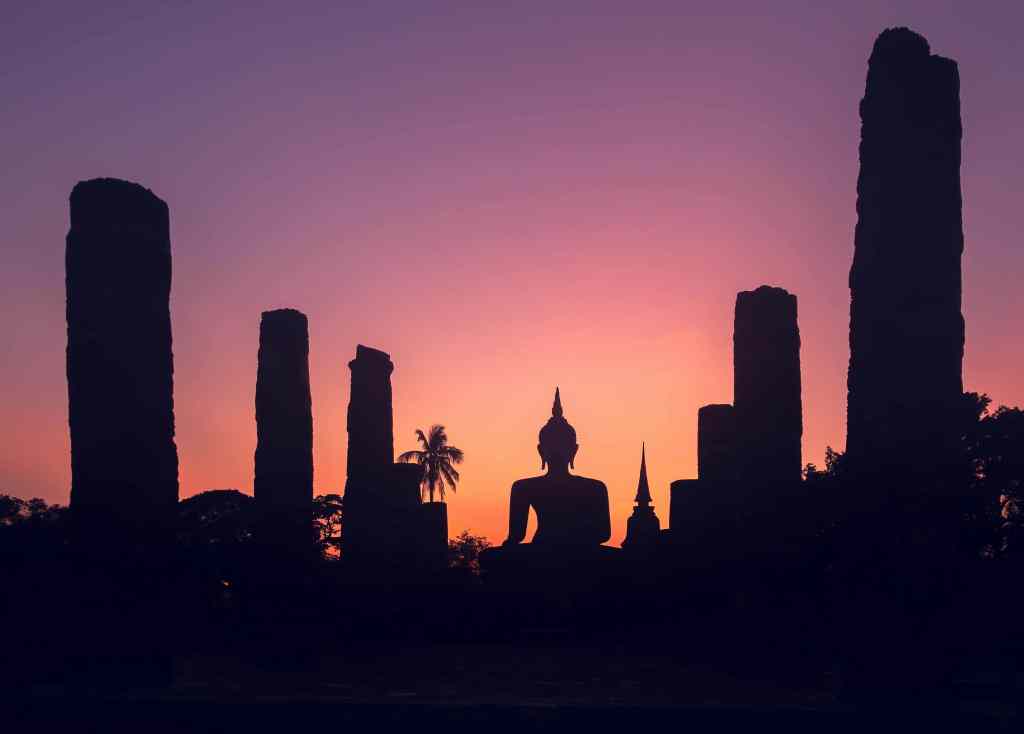
Once upon a time, in 563 BC, a prince was born in Lumbini, Nepal. He was named Siddhartha Gautam, born into the Shakya clan, destined to inherit the throne from his father. During his birth celebrations, a hermit foretold that Siddhartha would either become a great king or a great religious leader.
Fearful that his son might choose the latter path, King Sudhodana, Siddhartha’s father, tried to shield him from anything that might make him question life and its values. The prince grew up confined in his luxurious castle. At 16, he married his cousin Yashodhara, as arranged by their families, a common practice at the time.
When Siddhartha was 29, his curiosity about the world beyond his castle walls became overwhelming. He asked his charioteer, Channa, to take him on a journey through the countryside. During this journey, he encountered the harsh realities of life and suffering, experiences that would change the course of his life and human history.
First, he saw an aged man and learned from Channa that aging and growing helpless were inevitable parts of life. He then saw a diseased person, a funeral procession, and finally a religious ascetic. Through these encounters, Siddhartha realized that everyone, including himself, was vulnerable to sickness, death, and loss. He learned that the ascetic had found contentment by renouncing worldly attachments and was on a spiritual path, free from the illusions of life.
Back at the palace, Siddhartha couldn’t shake these revelations from his mind. One night, after a celebration, he wandered through the palace, reflecting on the fleeting nature of his luxuries. He realized that desire was the root of all pain.
Growing up in the Vedic society, Siddhartha knew of the cycle of Samsara, which ensured that people experienced inevitable pain and suffering in each life. He accepted that he could no longer live contentedly as a prince. That night, he left the palace, embarking on a journey of self-reflection and the search for liberation from Samsara.
During this period, the Indian subcontinent was rooted in Vedic traditions, but the Sramana movement was also emerging. This movement, which began around 800–600 BCE, involved people seeking spiritual freedom by rejecting the authority and rituals of the Brahmins. They followed an austere path, renouncing marriage, family, and various indulgences. Siddhartha joined this movement, hoping to find an escape from Samsara.
Initially, Siddhartha pursued extreme austerity. However, as he grew emaciated and near death, he realized that this extreme path could not lead to liberation. He gave up on austerity and decided to meditate under a tree. As his meditation deepened, he rid himself of all desires and attained enlightenment. Thus, the prince Siddhartha Gautam became the Buddha, the enlightened one.
Buddha discovered that the path to escape Samsara was the Middle Path, avoiding both extremes of indulgence and self-torture. He taught his followers the Four Noble Truths to achieve eternal peace and joy: life is permeated with suffering, the cause of suffering is desire, desire can be eliminated, and the way to eliminate it is to follow the Eightfold Path, which includes right view, right intention, right speech, right action, right livelihood, right effort, right concentration and right mindfulness.
Buddha’s teachings transformed into a religion that spread throughout Asia and the world. Buddhism, as much a philosophy as a religion, focuses more on practice than belief. This makes it relevant to people regardless of their religious beliefs. One can be agnostic or atheist and still find value in Buddhist practices, applying its teachings to lead a more peaceful and balanced life.
I believe Buddha’s teachings, especially regarding desire, are even more relevant today. In our materialistic world, amplified by the internet and social media, we are constantly bombarded with desires. While not everyone may strive to eliminate all desires like Buddha, we can all benefit from curbing some of these endless surges of desire. Practices like meditation can help us control our minds, desires, and lives.
Around the same time that Hinduism and Buddhism were developing in the Indian subcontinent, significant religious developments were also taking place in the Middle East, in the regions of Mesopotamia and Egypt. These developments would later have a profound impact on world religion and human history.
Next, we travel to modern-day Iraq and back to around 1800 BC, for the story of a man and his two sons.






 Nepali Wanderer
Leave a comment