Let’s start our piece with one more story. (For Christ’s Sake!)
The central figure and religious leader of Christianity, Jesus Christ, is one of the most prominent names in history. The most-followed calendar on earth is based on his birth, divided into Before Christ (BC) and Anno Domini (AD), which in Latin means “in the year of the Lord.” This alone signifies how influential Jesus is, not only among his followers but in the entirety of human history.
Jesus was born into a Jewish family in the Judea province in 4 BC. Although born in Bethlehem, it is believed that Joseph, the patriarch of Jesus, took his family and fled to a place called Nazareth (which is why he is often referred to as Jesus of Nazareth) to protect Jesus from Herod, the Roman-appointed king of Judea at the time.
The region was part of the Roman Empire, which followed polytheism, worshipping many gods and goddesses. In addition, Roman emperors enjoyed a cult status, with some being revered as divine. The Jews, with their monotheistic belief in one God, faced persecution in their own land.
Jesus began his religious journey in his 30s after being baptized by John the Baptist, who, upon seeing Jesus, is believed to have pronounced him as the Son of God. Jesus then went on to meditate and later traveled to different villages, spreading his beliefs and gaining disciples. He is believed to have helped people, healed the sick and elderly, and, according to legend, performed miracles, such as turning water into wine.
His followers came to believe he was no less than God. However, as Jesus grew in prominence as an influential leader and preacher, the emergence of another influential Jewish prophet alarmed and frightened the Romans, especially since Jesus was often called “the King of the Jews” by his disciples. Jesus was taken to the high court, where he was mocked, berated, and condemned for his claims. He was later crucified and buried in a tomb, presumably dead.
After Jesus’s death, his disciples created a new religion based on his life and teachings. What began with a small number of Jewish followers in Judea eventually became the most followed religion on earth. Ironically, the same Romans who persecuted Jesus would later make him the most revered figure in Christianity.
Despite continuous persecution by Roman emperors, Christianity gradually found a significant presence in the Empire. As Christianity’s influence grew, the strength of the Roman Empire waned. The Empire divided into four states (known as the tetrarchy), marred by constant battles and instability. Amidst this chaos, a figure emerged who would shape the fate of the Roman Empire and Christianity.
In 312 AD, Constantine, one of the tetrarchs, defeated his rivals and unified the Roman Empire under his rule. According to legend, a vision inspired Constantine to victory. Before a crucial battle, he saw a cross of light above the sun. The cross, a well-known Christian symbol, was seen as a divine sign. Constantine led his troops with this symbol and won the battle. Buoyed by this victory, Constantine converted to Christianity and legalized it in the Roman Empire, where it eventually became the principal religion.
This divine inspiration theme would be repeated in numerous conquests, shaping human history through the notion of “doing it in the name of God.”
Constantine’s legacy extended beyond his conversion. Unifying both the Eastern and Western parts of the Roman Empire, he felt the need for a new capital in the East, which was more developed and included Christianity’s religious center, Jerusalem. Thus, he founded Constantinople, named after himself.
Constantinople became one of the most important cities on earth. The Greek-speaking Eastern Roman Empire (later known as the Byzantine Empire) outlasted the Latin-speaking Western Roman Empire, which fell in 476 AD. The Byzantine Empire endured for nearly a thousand more years, falling in 1453 to the Ottomans.
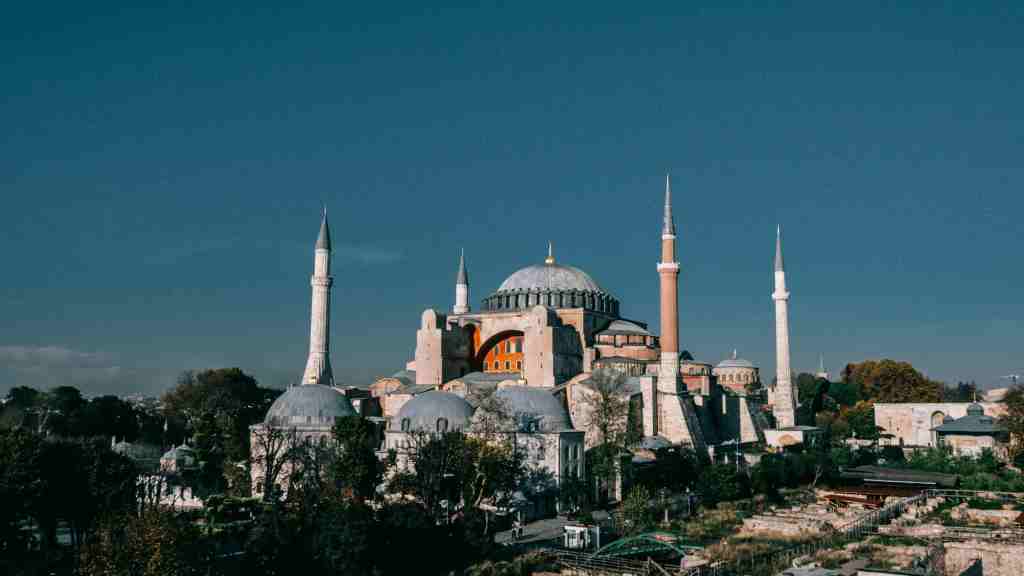
Constantinople, created by a Christian-inspired emperor, became the capital of an Islamic empire. Renamed Islambol (the City of Islam) under the Ottomans, it eventually became known as Istanbul. This city, where “the East Meets the West,” lies in two continents and embodies the blend of Roman, Byzantine, and Ottoman influences. One iconic monument that epitomizes this blend of religious and historical influences is the Hagia Sophia.
Originally built as a church in 537 AD, Hagia Sophia was the symbol of Eastern Christianity for nearly a thousand years. The fall of Christian Constantinople transformed it into a mosque under Islamic rule. It became a museum in 1934 and reverted to a mosque in June 2020, demonstrating that religion still influences history today.
Now that we have talked about Hagia Sophia and the Islamic empire, it’s a perfect time to take a detour to the Arabian Peninsula. Time to trace the origin of Islam.






 Nepali Wanderer
Leave a comment