
In January 2023, I went to Kerala for a month-long yoga course. It was a residential Teacher Training Course (TTC), with daily schedule from 5 AM to 10 PM. A year and a half later, it makes me reflect on a particular moment. In our orientation, one past student volunteer described TTC as a “Total Transformation Course.” While I wouldn’t call it total, it was transformative in every sense.
Backdrop
I love exploring new things and seeking experiences that challenge me. On the other hand, I also had my struggles with weight gain and loss, which led me to try everything from boxing to CrossFit. So, in a way, it was also the coming together of these two threads. However, it was my fascination with the spiritual world and meditation that primarily drew me to yoga. Since meditation was a significant part of my life, yoga seemed like a natural fit, if only to help me keep my back straight during meditation. Thus, from 2021 onwards, I had one goal: to learn yoga.
However, there was one problem — my unusual learning style. I knew I’d easily get demotivated (and eventually give up) in a typical few-hours-a-week yoga class. So, I decided to adopt the “sink or swim” philosophy, which meant joining a residential yoga course directly. This required at least 1.5 months of completely free time and a suitable residential yoga center.
Ultimately, I found the perfect place at Sivananda Ashram in Kerala. I wanted a place deeply rooted in Hindu spiritualism to experience the ancient yogic lifestyle. As for Kerala, I was convinced it was the place where I could truly learn yoga from my previous visit. Finally, in January 2023, I went to Sivananda Ashram to start a new chapter of my life.
The Beginning
On the very first day, when asked to define yoga, a friend replied, “Atma se Paramatma ko milna” (Union of the inner soul with the universal soul). This contrasted sharply with the common perception of yoga as merely physical exercise. The word “yoga” means union, and in Hindu spiritualism, it signifies the union of Atma (inner soul) with Brahman (universal soul). Or if you don’t want to bring in the soul angle, you can simply see it as the union of mind and body.
The ancient teachings present four paths for pursuing this union, known as the four paths of yoga:
- Karma Yoga: Through selfless work and renunciation of the fruits of action.
- Bhakti Yoga: Union with the divine through devotional love and surrender.
- Gyana Yoga: Through inquiry into the nature of the self through study and investigation.
- Raja Yoga: Union of mind, body, and soul through meditation and asanas.
And if you consider the Eight Limbs of Yoga (Ashtanga) given by Patanjali, Asana (physical posture) is just one of the eight limbs. So, the physical postures we commonly associate with yoga constitute only a small fraction of Yoga. Our schedule at Sivananda Ashram was built around the four paths of Yoga to practice the Yogic Life.
Schedule

Bhakti Yoga
We started and ended our day with Bhakti Yoga, singing devotional songs. Although I am not much into this practice, I gradually began to see it as a fun and positive experience. The whole point of Asharam experience was to be open to exploration and not complain. I could also see the effect of Bhakti Yoga on many of my friends, showcasing why different paths are laid out for different people.
Karma Yoga
Every day, we had to do one hour of selfless work. I was assigned the task of sweeping (which soon included mopping) the dorm. I’ll be honest — it wasn’t an easy experience at first, but I slowly began to understand the purpose of the activity. It naturally instilled a positive feeling of doing work for others. It also made me realise how much we take for granted, like the cleanliness of the ashram, which was thanks to someone else’s hard work. Lastly, it made us efficient in terms of time management, as we had to finish our tasks to keep up with the already tight schedule. I still fondly remember the tight schedule of finishing the task in time to take a shower before our lecture.
Gyana Yoga
We had separate lectures on Vedanta and the Bhagavad Gita as part of our Gyana Yoga. I had read a few Upanishads and the Gita before, so the core philosophy of Vedanta wasn’t new to me. (I will write a separate story on how 99% of Hindus I have met, including myself for a long time, have no idea about Vedanta.) However, it was enlightening to learn about Vedanta and the Gita from a knowledgeable teacher. The discourses, discussions, and even the little debates following the lectures helped me learn new things and broaden my understanding.
There was one part I particularly enjoyed: doing daily homework from the lectures. First, because it was something closer to my lifestyle compared to other activities. Second, it gave us the chance to relive our college days. Reminiscing about our homework sessions, sitting in groups, studying together, and occasionally copying work still brings a smile to my face.
Raja Yoga
For Raja Yoga, we had two daily sessions of meditation and yogasanas. For meditation, we could either follow the guided meditation of the ashram or our own style (I practiced Vipassana some days). As for yogasanas (the typical yoga we associate with), we had two detailed 2-hour sessions each day, morning and evening.
Yogasana
I still remember my first-ever yoga session. Since it was our first day, we had a “do-whatever-you-can” session. I recall feeling puzzled as I watched others during the Surya Namaskar. Along with bewilderment, there was some fun in imitating whatever I could, like a newborn baby. After subsequent detailed beginner classes, I slowly started learning the asanas. Our ashram focused on 12 basic asanas that involved all body parts from top to bottom, with additional advanced asanas in subsequent weeks. We also had theoretical lectures on anatomy and physiology, with lessons on the different benefits of each yogasana.
As an absolute beginner, it was a special learning experience for me. By learning about my own body, I was learning about myself. Compared to evaluating internal transformations, it is easier to evaluate apparent bodily transformation. Thus, it was special seeing that transformation in myself. There were many difficult moments during the course, times when I felt I was the most incapable in the class. I remember not being able to do a headstand even until the end, while seeing some other beginners achieve it.
Yet, I was mostly relaxed and happy about my own progress. Maybe it was the ashram lifestyle and my own learnings from the past that helped me avoid comparison. We often forget that every person has a different journey and even seemingly similar beginners have different starting points. So, I was more than happy with whatever I could learn without pushing my body beyond its limits.

Living in a Different World
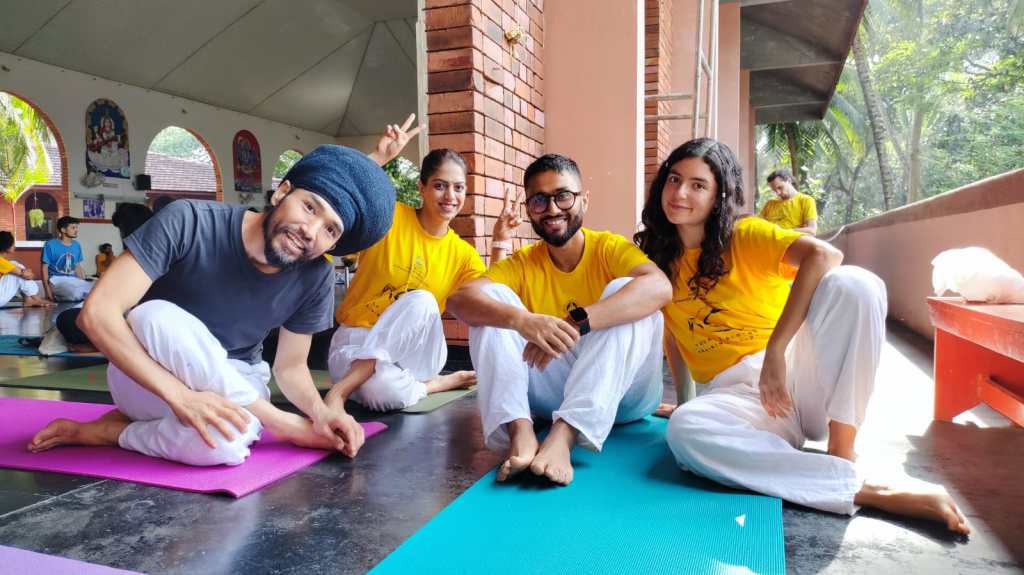
Apart from learning yoga through different paths, just living in the ashram for a month was special. The secluded location in the beautiful Western Ghats of Kerala, the right outside Neyyar Dam, and nearby small villages made the ashram a nature’s paradise in every sense. The ambiance inside was even more special because of the people in the ashram. There were people from all over the world, with diverse backgrounds and experiences, some coming to learn yoga, some Ayurveda, and some just for a yoga vacation, all connected by the common thread of spirituality.
The different weekly structure, with only Friday off, created a feeling of living aloof from the outside world (with Thursday night suddenly giving that weekend feeling). We would even do the spiritual walk once a week, walking with awareness to the nearby dam, and singing devotional chants there. One day, we even hiked (silently) to a nearby hill, from where we could fully appreciate the surrounding hills and vista.
Every Saturday night, we had a talent show where people from diverse cultures showcased whatever they felt comfortable with. I saw it as my best opportunity to tick off one personal bucket list item: performing on a stage where no one would judge my singing and guitar skills. So, I performed twice. I started with a Nepali and an English song in my first performance and signed off with a Hindi song in the second.
And, of course, I can’t end this section without mentioning the food. The daily Satvik vegetarian food made me realise how eating healthy is connected to our well-being. It’s one thing to read about this in the Gita or a nutrition book, but doing so every day for a month and seeing the effect on yourself is the actual learning. Satvik vegetarian food can be innovative too, as we were surprised with a Satvik Sushi day by our amazing yoga friends from Japan.
Teaching and Final Evaluation
As we were doing a Teacher Training Course, we had to be serious about the teachings and theories, and importantly, learn how to teach. As part of the evaluation, we had to teach a team of four in a 90-minute yoga session. Initially, I wasn’t worried about the teaching part, as it was a natural role for me. But this was not data science teaching with a board and marker, so I got nervous on the day of teaching. Luckily, a friend, who was also there just to learn yoga and not become a teacher (at least for now), made me realise something deep: it could be the only time we ever taught a yoga class. That insight helped me fully enjoy those 90 minutes and deliver as a yoga teacher.
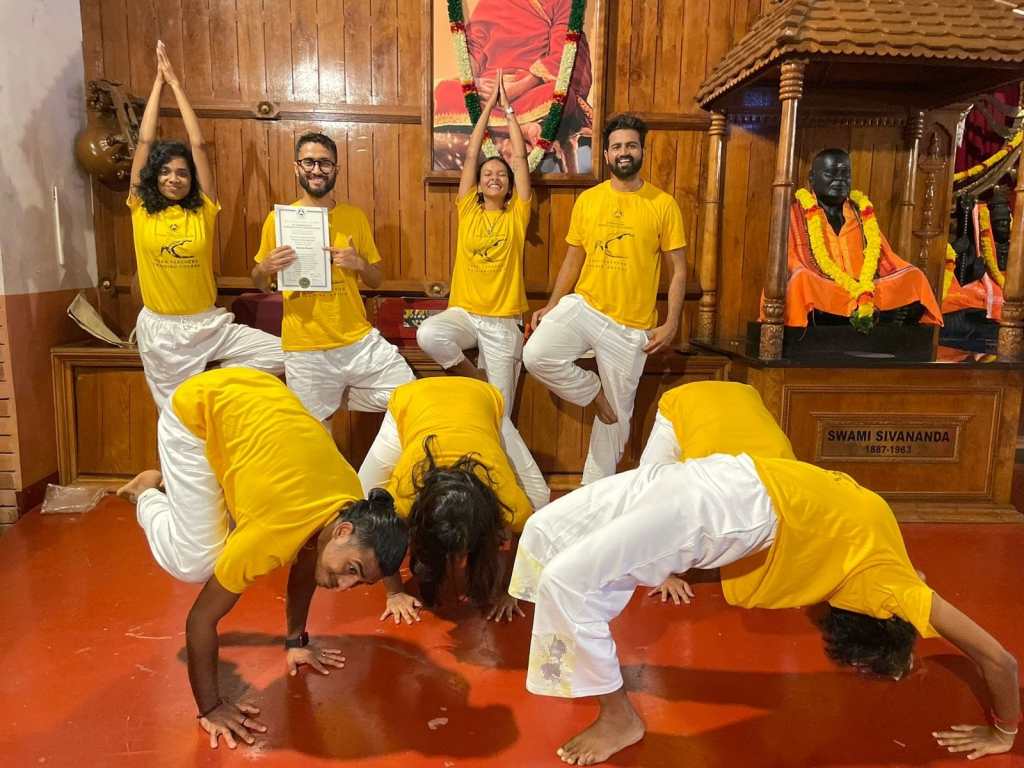
Then we had to take a final written exam based on theoretical spiritual teachings, the history of yoga, anatomy, and physiology. As this was my forte, I had fun preparing for and taking the exam. The final handing over of the answer sheet was special, as it always had been throughout my life. Some feelings are always special, like the feeling of an exam being over, no matter where you are or how old you are. At the end of the month, we had our graduation, where we received our certificates, followed by picture sessions and the creation of lifelong memories.
Transformation
As I mentioned above, it’s difficult to measure transformation in your life. Bodily transformation is perhaps the easiest to see, which might be why many ancient yogis started their transformative journey with their bodies. Another way to see transformation is through changes in habits. One month in the ashram not only instilled discipline in me but also made me realise how much can be accomplished in a single day.
Then there’s spiritual transformation, which I have felt most during my meditation. Practicing yogasanas has not only improved my meditation practice but also become a substitute on days when I find it difficult to meditate. Life has its ups and downs, and we go through bright and dark phases. Yogasanas can be your companion, especially during dark phases. One final transformational lesson I have learned is being open to the universe, as that’s the natural way for transformation.
Aftermath
I remember coming home with the confident hope of practicing yogasanas every day. And I did so, until I had a bike accident two months later. This meant I could not do yogasanas for the next six months. Despite occasional frustrations and worries (if I would forget everything), my experience in the ashram helped me stay patient. I persisted with my meditation practice, knowing that the overall goal of yoga extended beyond yogasanas. Six months later, when I finally started my yogasanas again, I quickly became irregular, making excuses not to practice. It was then my memories from the ashram — the time I had invested, and the fun-sacrifices I had made — that pushed me to pick up yogasanas again.
More than one and a half years later, here I am, happy to say I practice yogasanas “somewhat” regularly (meaning five days a week). Sometimes, the quick bursts of body-to-mind changes (like changing how you feel after just one or two asanas) make me appreciate the magic of yogasanas. But more importantly, it is the slow long-term transformations I see over time, and the realisation that progress takes time, that make me positive in other spheres of life. In that respect alone, I think our TTC course was indeed transformative.

PS: I finally managed to do a headstand after a good few months of patience.





 Nepali Wanderer
Leave a comment