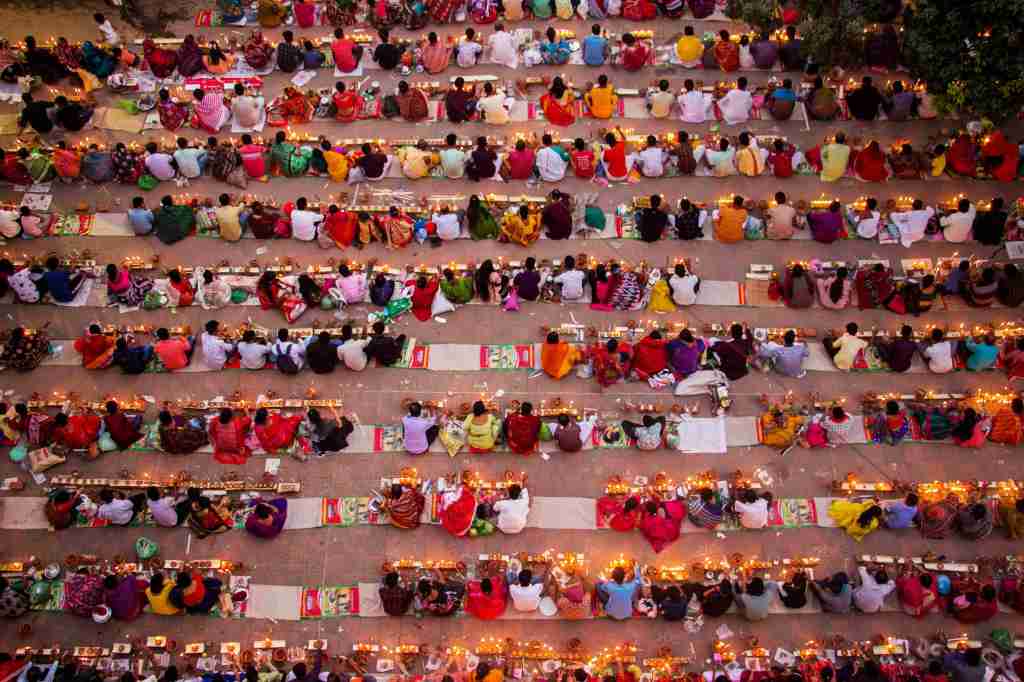
Photo by Rayhan Ahmed
Religion, the ultimate human creation, has left an indelible mark on our lives, whether we’re devout believers or dedicated skeptics. Before we begin, let’s make one thing clear — I am not here to question the existence of God or rain on anyone’s spiritual belief. I’m a firm believer in free will and the right to believe.
Remember the time when you first learned about the concept of God? Yeah, me neither. It’s one of those things we absorb as children, almost like our mother tongue. But our quest is not to discuss the origin of God. Instead, we’re diving into the origins of religion, a human creation that even the most devout can agree upon.
Broadly speaking, religion can be defined as some sort of a shared reverence for a God or Deity or Supernatural, that is often institutionalized and associated with particular God/Gods, rituals, symbols, and sacred books. Hence, to trace the origin of religion, tracing the origin of these shared rituals and reverence is vital.
To do so, let’s ponder the age-old chicken-or-the-egg question — did culture give birth to religion, or did religion give rise to culture? And to make it even more interesting, did morality come first, giving rise to both culture and religion, or did it emerge from culture and religion?
Let’s start by discussing culture. Cultures can be seen as the collective behaviors adopted by groups and passed down through generations. Just as beneficial physical traits are passed down through evolution, cultures also evolve and are refined by natural selection. Behaviors beneficial for survival become long-standing rituals over time.
If we think about it, rituals are the prerequisite for religions. So, in that sense, culture must precede religion. We can take the ritual of meal sharing, a pivotal behavior that aided in the survival of our ancestors, as one example. Almost all the religions practiced today have rituals related to the sharing of food or meal in a way or the other.
But before passing down the behaviors, it was important for our ancestors to identify good behaviors (meaning beneficial for collective survival) from the bad ones. This process required a sense of right and wrong, which is essentially morality. Without a basic understanding of good and bad, and a sense of fairness and reciprocity, cooperation would have been impossible. Consequently, morality must also precede religion (and culture).
Till now, we have discussed all about “staying together” and “sharing together”. But let’s not forget the crucial element of “reverence.” Yes, that’s the secret element that completes religion. After all, it’s not like religion just sprung from someone’s wild imagination and everyone fell for it, for people need to feel something too.
Enter spiritualism, the magic ingredient that takes religion to the next level. While one could very well be spiritual without being religious, it is the intertwining of religion with spiritualism that made it possible for a large number of humans to experience and share reverence. Nature, that way, is the inspiration for our early religions, as people could experience reverence in its presence. No wonder most of the early religions such as Shamanism and Paganism were based on nature (like the Sky god, Land god, Ocean god, and so on).
Over time, humans began incorporating essential elements of nature into their concept of gods. The Fire god is a prime example, still prevalent in some of the earliest religions practiced today. These gods and religious beliefs differ greatly across various cultures, morals, and societies. For instance, the same cow revered as a goddess in Hinduism is consumed as food in other religions.
The Agricultural Revolution then led to the advent of organized modern religions, with priests and kings playing a massive role in its organization. However, fundamental questions remained unanswered, such as the origins of the universe, life, and death. The answers came in the form of messengers, a common denominator in almost all modern-day religions. The prophets and sages, believed to have received these messages as revelations from God, were trusted by others. It was through these messengers and their revelations that modern religions like Hinduism, Judaism, Christianity, and Islam were formed.
To sum up, the origin of religion cannot be pinpointed to a single moment in history. The evolution of religion spans thousands of years, much like the evolution of humans. Since we have more detailed information on human history from the last 5,000 years, we sometimes mistakenly attribute everything to this period. But important gradual developments in religion occurred thousands of years earlier. Observing primates like chimpanzees, which share a common ancestor with us, we can surmise that the foundational elements of religion — such as playful rituals, a sense of reciprocity, and experiential aspects — could predate even the Homo genus.
Today, we can develop culture, and be moral and spiritual without adhering to religion. However, it was through religion that culture, spiritual and moral beliefs were long carried. Many people still seek to find all three in religion. Even today, when asked why they believe in moral principles like “one should not steal even when no one is watching,” some people answer, “Because God is watching.”
In our journey to trace the influence of religion, we will begin with the oldest religion on Earth. We will travel to the Indian Subcontinent to trace the origin of Hinduism.







 Nepali Wanderer
Leave a comment